
 VAQORA
Cuprous oxide, 99.9%
Synonyms: Copper(I) oxide · Dicopper oxide · Cuprite · Red copper oxide
CAS No.1317-39-1
FormulaCu2O
Mol. weight143.09
Catalogue No.VQ-014649
Purity99.9%
HSN28255000
Cuprous oxide (CAS 1317-39-1) – transition metal compound, Puriss grade, 99.9%. Cu2O, MW 143.09. Order from Vaqora Chemicals with COA and global delivery.
Pack sizesPrice on quotation · bulk available
5 g
25 g
100 g
4 x 25 kg
Bulk / custom pack · kg to MT
Enquire Batch COA with every lot
16-section GHS SDS
Export to 120+ countries
DG-compliant packing
About Cuprous oxide, 99.9%
Listed under CAS 1317-39-1, Cuprous oxide is a transition metal compound available from Vaqora Chemicals (Puriss grade) at a purity of 99.9%. The compound has the formula Cu2O, corresponding to a molecular weight of 143.09 g/mol. The IUPAC name is copper. Oxocopper. Alternative names: Copper(I) oxide and Dicopper oxide.
In its supplied form it is a powder brownish-red solid. Reported physical data include a melting point of 1235° and a density of 6 g/mL at 25 °C. Solubility: insoluble (water). Store in a tightly closed container in a cool, dry and well-ventilated place. It carries the GHS signal word “Danger” with 5 hazard statements. Review the Safety Data Sheet before use.
Key uses span dyes and pigments manufacture, paints, coatings and inks and ceramics and glass. Our customers for this product work in academic and industrial research.
Available in 5 g, 25 g, 100 g and 4 x 25 kg packs, Cuprous oxide is dispatched with a Certificate of Analysis (COA) to destinations worldwide.
Typical applications
- Dyes & pigments manufacture
- Paints, coatings & inks
- Ceramics & glass
Industries
Specifications & identifiers
| Product name | Cuprous oxide, 99.9% |
|---|---|
| Catalogue No. | VQ-014649 |
| CAS Number | 1317-39-1 |
| IUPAC name | copper;oxocopper |
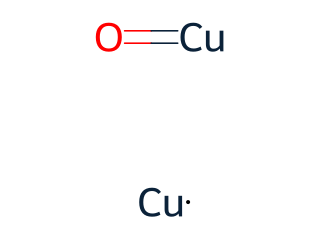
| Molecular formula | Cu2O |
| Molecular weight | 143.09 g/mol |
| Exact mass | 141.8541 |
| Grade | Puriss |
| Purity / assay | 99.9% |
| HSN code | 28255000 |
| InChIKey | BERDEBHAJNAUOM-UHFFFAOYSA-N |
| SMILES | O=[Cu].[Cu] |
| PubChem CID | 18346908 |
| Physical form | Powder |
|---|---|
| Appearance | Powder brownish-red solid |
| Melting point | 1235° |
| Density | 6 g/mL at 25 °C |
| Solubility | Insoluble (water) |
| H-bond donors / acceptors | 0 / 1 |
| TPSA | 17.1 Ų |
| UN number | UN 3077 |
| Synonyms | Copper(I) oxide, Dicopper oxide, Cuprite, Red copper oxide, (cupriooxy)copper, Brown copper oxide, copper (I) oxide, Copper hemioxide, Copper Nordox, Copper oxide (Cu2O), Copper oxide, red, Copper protoxide |
Safety & hazard information (GHS)


Signal word: Danger
Hazard statements
H302Harmful if swallowedH318Causes serious eye damageH332Harmful if inhaledH400Very toxic to aquatic lifeH410Very toxic to aquatic life with long lasting effects
Precautionary statements: P261, P264, P264 + P265, P270, P271, P273, P280, P301 + P317, P304 + P340, P305 + P354 + P338, P317, P330, P391, P501
Classification is indicative (aggregated GHS notifications) and may vary by grade and concentration. Always refer to the SDS supplied with your lot.
Documents
Other grades of CAS 1317-39-1
Frequently asked questions
What is the CAS number of Cuprous oxide, 99.9%?
The CAS Registry Number of Cuprous oxide, 99.9% is 1317-39-1. It is also known as Copper(I) oxide, Dicopper oxide, Cuprite.
What is the molecular formula and molecular weight of Cuprous oxide, 99.9%?
Cuprous oxide, 99.9% has the molecular formula Cu2O and a molecular weight of 143.09 g/mol.
Which grade and pack sizes of Cuprous oxide, 99.9% can I order?
We supply Cuprous oxide, 99.9% in Puriss (99.9%) grade, in 5 g, 25 g, 100 g, 4 x 25 kg packs. Larger bulk quantities and custom packing are quoted on request.
Do you provide a COA and SDS with Cuprous oxide, 99.9%?
Yes. Every lot of Cuprous oxide, 99.9% is shipped with a batch-specific Certificate of Analysis, and a 16-section GHS Safety Data Sheet is provided with the quotation and the shipment.
Can Cuprous oxide, 99.9% be shipped internationally?
Yes. Cuprous oxide, 99.9% is classified as hazardous (UN 3077), so it is packed in UN-approved packaging and shipped as dangerous goods under IATA/IMDG rules. We export worldwide on EXW, FOB, CIF and DAP terms.
Enquire about Cuprous oxide, 99.9%
We reply within one business day with price, pack options, lead time and documentation.
 Australia
 Bangladesh
 Belgium
 Brazil
 Canada
 China
 Egypt
 France
 Germany
 India
 Indonesia
 Ireland
Related products
More in Transition Metal Compounds (Fe, Co, Ni, Cu, Zn, Mn, Cr) →