 VAQORA
XTT sodium salt, suitable for cell culture
Synonyms: 2,3-Bis(2-methoxy-4-nitro-5-sulfophenyl)-2H-tetrazolium-5-carboxanilide inner salt · 2,3-bis[2-Methoxy-4-nitro-5-sulfophenyl]-2H-tetrazolium-5-carboxanilide inner salt · XTT, sodium salt · Sodium 2,3-bis(2-methoxy-4-nitro-5-sulfophenyl)-2H-tetrazolium-5-carboxanilide inner salt
CAS No.111072-31-2
FormulaC22H16N7NaO13S2
Mol. weight673.50
Catalogue No.VQ-000734
Purity90%
HSN29420090
XTT sodium salt (CAS 111072-31-2) – biological stain, Cell Culture grade, 90%. C22H16N7NaO13S2, MW 673.5. Vaqora Chemicals: COA, global shipping.
Pack sizesPrice on quotation · bulk available
25 mg
100 mg
500 mg
1 g
Bulk / custom pack · kg to MT
Enquire Batch COA with every lot
16-section GHS SDS
Export to 120+ countries
DG-compliant packing
About XTT sodium salt, suitable for cell culture
XTT sodium salt (CAS 111072-31-2) is a biological stain offered by Vaqora Chemicals in Cell Culture grade at a purity of 90%. With the molecular formula C22H16N7NaO13S2, it has a molar mass of 673.5 g/mol. Common synonyms include XTT, sodium salt and XTT sodium salt, analytical standard, >=90%.
It is supplied as a faint yellow to light yellow to dark yellow to brown yellow powder. Keep the material at 2–8 °C and protect it from moisture. Handle it with standard laboratory precautions and appropriate personal protective equipment.
Key uses span histology and cytology staining, microscopy, clinical laboratories and cell and microbial culture. Our customers for this product work in academic and industrial research, diagnostics and biotechnology and textiles and dyeing.
Available in 25 mg, 100 mg, 500 mg and 1 g packs, XTT sodium salt is dispatched with a Certificate of Analysis (COA) to destinations worldwide.
Typical applications
- Histology & cytology staining
- Microscopy
- Clinical laboratories
- Cell & microbial culture
Industries
Specifications & identifiers
| Product name | XTT sodium salt, suitable for cell culture |
|---|---|
| Catalogue No. | VQ-000734 |
| CAS Number | 111072-31-2 |
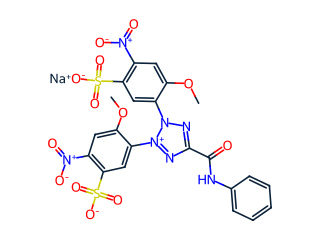
| IUPAC name | sodium 4-methoxy-5-[3-(2-methoxy-4-nitro-5-sulfonatophenyl)-5-(phenylcarbamoyl)tetrazol-3-ium-2-yl]-2-nitrobenzenesulfonate |
| Molecular formula | C22H16N7NaO13S2 |
| Molecular weight | 673.5 g/mol |
| Exact mass | 673.0145 |
| Grade | Cell Culture |
| Purity / assay | 90% |
| HSN code | 29420090 |
| InChIKey | JACYMBNQPPWQML-UHFFFAOYSA-M |
| SMILES | COC1=CC(=C(C=C1N2N=C(N=[N+]2C3=CC(=C(C=C3OC)[N+](=O)[O-])S(=O)(=O)[O-])C(=O)NC4=CC=CC=C4)S(=O)(=O)[O-])[N+](=O)[O-].[Na+] |
| PubChem CID | 14195569 |
| Physical form | Powder |
|---|---|
| Appearance | Faint yellow to light yellow to dark yellow to brown yellow powder |
| H-bond donors / acceptors | 1 / 15 |
| TPSA | 305 Ų |
| Storage | 2–8 °C |
| Synonyms | 2,3-Bis(2-methoxy-4-nitro-5-sulfophenyl)-2H-tetrazolium-5-carboxanilide inner salt, 2,3-bis[2-Methoxy-4-nitro-5-sulfophenyl]-2H-tetrazolium-5-carboxanilide inner salt, XTT, sodium salt, Sodium 2,3-bis(2-methoxy-4-nitro-5-sulfophenyl)-2H-tetrazolium-5-carboxanilide inner salt, XTT sodium salt, analytical standard, >=90%, XTT sodium salt, powder, BioReagent, suitable for cell culture, Sodium 2,3-bis(2-methoxy-4-nitro-5-sulfophenyl)-2H-tetrazolium-5-carboxanilide, sodium 3,3'-(1-(phenylamino)carbonyl)-3,4-tetrazolium-bis(4-methoxy-6-nitro)be |
Documents
Other grades of CAS 111072-31-2
Frequently asked questions
What is the CAS number of XTT sodium salt, suitable for cell culture?
The CAS Registry Number of XTT sodium salt, suitable for cell culture is 111072-31-2. It is also known as 2,3-Bis(2-methoxy-4-nitro-5-sulfophenyl)-2H-tetrazolium-5-carboxanilide inner salt, 2,3-bis[2-Methoxy-4-nitro-5-sulfophenyl]-2H-tetrazolium-5-carboxanilide inner salt, XTT, sodium salt.
What is the molecular formula and molecular weight of XTT sodium salt, suitable for cell culture?
XTT sodium salt, suitable for cell culture has the molecular formula C22H16N7NaO13S2 and a molecular weight of 673.5 g/mol. Its IUPAC name is sodium 4-methoxy-5-[3-(2-methoxy-4-nitro-5-sulfonatophenyl)-5-(phenylcarbamoyl)tetrazol-3-ium-2-yl]-2-nitrobenzenesulfonate.
Which grade and pack sizes of XTT sodium salt, suitable for cell culture can I order?
We supply XTT sodium salt, suitable for cell culture in Cell Culture (90%) grade, in 25 mg, 100 mg, 500 mg, 1 g packs. Larger bulk quantities and custom packing are quoted on request.
Do you provide a COA and SDS with XTT sodium salt, suitable for cell culture?
Yes. Every lot of XTT sodium salt, suitable for cell culture is shipped with a batch-specific Certificate of Analysis, and a 16-section GHS Safety Data Sheet is provided with the quotation and the shipment.
Can XTT sodium salt, suitable for cell culture be shipped internationally?
Yes. We export XTT sodium salt, suitable for cell culture worldwide by air and sea freight or express courier, on EXW, FOB, CIF, CFR or DAP Incoterms, with full export documentation.
How should XTT sodium salt, suitable for cell culture be stored?
2–8 °C. Keep the container tightly closed and refer to the SDS for full handling guidance.
Enquire about XTT sodium salt, suitable for cell culture
We reply within one business day with price, pack options, lead time and documentation.
 Australia
 Bangladesh
 Belgium
 Brazil
 Canada
 China
 Egypt
 France
 Germany
 India
 Indonesia
 Ireland
Related products


Xylenol orange tetrasodium salt, ACS reagent
- CAS
- 3618-43-7
- Formula
- C31H28N2Na4O13S
- MW
- 760.58 g/mol
VQ-000736