 Australia
 Bangladesh
 Belgium
 Brazil
 Canada
 China
 Egypt
 France
 Germany
 India
 Indonesia
 Ireland
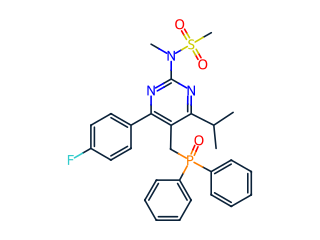
N-(5-((Diphenylphosphoryl)methyl)-4-(4-fluorophenyl)-6-isopropylpyrimidin-2-yl)-N-methylmethanesulfonamide
- CAS
- 289042-10-0
- Formula
- C28H29FN3O3PS
- MW
- 537.6 g/mol
VQ-027905
 VAQORA
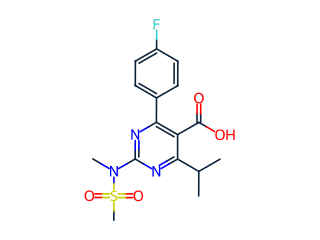
Synonyms: 4-(4-fluorophenyl)-6-isopropyl-2-(N-methylmethylsulfonamido)pyrimidine-5-carboxylic acid · 4-(4-fluorophenyl)-6-isopropyl-2-[methyl(methylsulfonyl)amino]pyrimidine-5-carboxylic acid
4-(4-Fluorophenyl)-6-(1-methylethyl)-2-[methyl(methylsulfonyl)amino]-5-pyrimidinecarboxylic acid (CAS 1263475-93-9) – Rosuvastatin impurity standard.
Vaqora Chemicals supplies 4-(4-Fluorophenyl)-6-(1-methylethyl)-2-[methyl(methylsulfonyl)amino]-5-pyrimidinecarboxylic acid, an impurity of Rosuvastatin registered under CAS number 1263475-93-9. The compound has the formula C16H18FN3O4S, corresponding to a molecular weight of 367.4 g/mol. Systematically, it is named 4-(4-fluorophenyl)-2-[methyl(methylsulfonyl)amino]-6-propan-2-ylpyrimidine-5-carboxylic acid.
It is supplied as a solid. Store the standard in its sealed vial, protected from light and moisture, and follow the storage condition printed on the COA. Good laboratory practice and suitable PPE are recommended during handling.
As a characterised impurity of Rosuvastatin, it is used for analytical method development, method validation (AMV) and routine quality-control testing, and it supports ANDA and DMF regulatory filings. It is used across pharmaceutical manufacturing and academic and industrial research.
We offer 4-(4-Fluorophenyl)-6-(1-methylethyl)-2-[methyl(methylsulfonyl)amino]-5-pyrimidinecarboxylic acid in 10 mg, 25 mg, 50 mg and 100 mg packs with a batch-specific COA, and ship to customers worldwide.
View every impurity, metabolite and intermediate we list for Rosuvastatin.
Rosuvastatin impurities| Product name | 4-(4-Fluorophenyl)-6-(1-methylethyl)-2-[methyl(methylsulfonyl)amino]-5-pyrimidinecarboxylic acid |
|---|---|
| Catalogue No. | VQ-027906 |
| CAS Number | 1263475-93-9 |
| IUPAC name | 4-(4-fluorophenyl)-2-[methyl(methylsulfonyl)amino]-6-propan-2-ylpyrimidine-5-carboxylic acid |
| Molecular formula | C16H18FN3O4S |
| Molecular weight | 367.4 g/mol |
| Exact mass | 367.1002 |
| Grade | Reference Standard |
| HSN code | 38229090 |
| InChIKey | CHMLXRMRDRNBMV-UHFFFAOYSA-N |
| SMILES | CC(C)C1=NC(=NC(=C1C(=O)O)C2=CC=C(C=C2)F)N(C)S(=O)(=O)C |
| PubChem CID | 69186656 |
| Physical form | Solid |
|---|---|
| LogP (XLogP3) | 2.1 |
| H-bond donors / acceptors | 1 / 8 |
| TPSA | 109 Ų |
The CAS Registry Number of 4-(4-Fluorophenyl)-6-(1-methylethyl)-2-[methyl(methylsulfonyl)amino]-5-pyrimidinecarboxylic acid is 1263475-93-9. It is also known as 4-(4-fluorophenyl)-6-isopropyl-2-(N-methylmethylsulfonamido)pyrimidine-5-carboxylic acid, 4-(4-fluorophenyl)-6-isopropyl-2-[methyl(methylsulfonyl)amino]pyrimidine-5-carboxylic acid.
4-(4-Fluorophenyl)-6-(1-methylethyl)-2-[methyl(methylsulfonyl)amino]-5-pyrimidinecarboxylic acid has the molecular formula C16H18FN3O4S and a molecular weight of 367.4 g/mol. Its IUPAC name is 4-(4-fluorophenyl)-2-[methyl(methylsulfonyl)amino]-6-propan-2-ylpyrimidine-5-carboxylic acid.
4-(4-Fluorophenyl)-6-(1-methylethyl)-2-[methyl(methylsulfonyl)amino]-5-pyrimidinecarboxylic acid is supplied as a characterised reference material related to Rosuvastatin. It is used for analytical method development and validation (AMV), impurity profiling, stability studies and quality control, and in ANDA/DMF regulatory filings.
We supply 4-(4-Fluorophenyl)-6-(1-methylethyl)-2-[methyl(methylsulfonyl)amino]-5-pyrimidinecarboxylic acid in Reference Standard grade, in 10 mg, 25 mg, 50 mg, 100 mg packs. Larger bulk quantities and custom packing are quoted on request.
Yes. Every lot of 4-(4-Fluorophenyl)-6-(1-methylethyl)-2-[methyl(methylsulfonyl)amino]-5-pyrimidinecarboxylic acid is shipped with a batch-specific Certificate of Analysis, and a 16-section GHS Safety Data Sheet is provided with the quotation and the shipment.
Yes. We export 4-(4-Fluorophenyl)-6-(1-methylethyl)-2-[methyl(methylsulfonyl)amino]-5-pyrimidinecarboxylic acid worldwide by air and sea freight or express courier, on EXW, FOB, CIF, CFR or DAP Incoterms, with full export documentation.
We reply within one business day with price, pack options, lead time and documentation.