
 Australia
 Bangladesh
 Belgium
 Brazil
 Canada
 China
 Egypt
 France
 Germany
 India
 Indonesia
 Ireland
 VAQORA
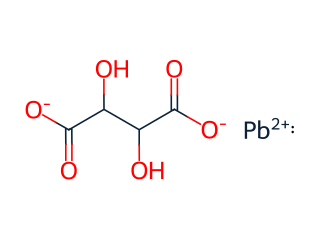
Lead tartrate
Synonyms: Lead(II) tartrate · L(+)Tartaric acid lead(II) salt · L-2,3-Dihydroxybutanedioic acid lead(II) salt · Butanedioic acid, 2,3dihydroxy (2R,3R), lead(2+) salt (1:1)
CAS No.815-84-9
FormulaC4H4O6Pb
Mol. weight355.00
Catalogue No.VQ-015307
Purity99%
HSN29181390
Lead tartrate (CAS 815-84-9) – main-group metal compound, Synthesis grade, 99%. C4H4O6Pb, MW 355.0. COA included. Worldwide shipping from Vaqora Chemicals.
Batch COA with every lot
16-section GHS SDS
Export to 120+ countries
DG-compliant packing
About Lead tartrate
Vaqora Chemicals supplies Lead tartrate (Synthesis grade), a main-group metal compound registered under CAS number 815-84-9, specified at 99% purity. With the molecular formula C4H4O6Pb, it has a molar mass of 355.0 g/mol. Systematically, it is named 2,3-dihydroxybutanedioate. Lead(2+). Alternative names: Lead(II) tartrate and L(+)Tartaric acid lead(II) salt.
The material typically appears as white to off-white powder or crystal or chunks. Literature values give a density of 2.53. Keep the container tightly sealed and store it in a cool, dry area. It carries the GHS signal word “Danger” with 5 hazard statements. Review the Safety Data Sheet before use.
Typical applications include organic synthesis and materials research. Buyers come mainly from academic and industrial research.
Available in 100 g, 500 g and 25 kg packs, Lead tartrate is dispatched with a Certificate of Analysis (COA) to destinations worldwide.
Specifications & identifiers
| Product name | Lead tartrate |
|---|---|
| Catalogue No. | VQ-015307 |
| CAS Number | 815-84-9 |
| IUPAC name | 2,3-dihydroxybutanedioate;lead(2+) |
| Molecular formula | C4H4O6Pb |
| Molecular weight | 355 g/mol |
| Exact mass | 355.9774 |
| Grade | Synthesis |
| Purity / assay | 99% |
| HSN code | 29181390 |
| InChIKey | AYPZCTCULRIASE-UHFFFAOYSA-L |
| SMILES | C(C(C(=O)[O-])O)(C(=O)[O-])O.[Pb+2] |
| PubChem CID | 61219 |
| Physical form | Crystalline |
|---|---|
| Appearance | White to off-white powder or crystal or chunks |
| Density | 2.53 |
| H-bond donors / acceptors | 2 / 6 |
| TPSA | 121 Ų |
| UN number | UN 3077 |
| Synonyms | Lead(II) tartrate, L(+)Tartaric acid lead(II) salt, L-2,3-Dihydroxybutanedioic acid lead(II) salt, Butanedioic acid, 2,3dihydroxy (2R,3R), lead(2+) salt (1:1), Butanedioic acid, 2,3dihydroxy (R(R*,R*)), lead(2+) salt (1:1), Butanedioic acid, 2,3dihydroxy (R(R*,R*)), lead(2+) salt (1:1) (9CI), Lead(II) 2,3-dihydroxysuccinate, C4H4O6Pb, Tartaric acid lead(II) salt |
Safety & hazard information (GHS)


Signal word: Danger
Hazard statements
H302Harmful if swallowedH332Harmful if inhaledH341Suspected of causing genetic defectsH351Suspected of causing cancerH372Causes damage to organs through prolonged or repeated exposure
Precautionary statements: P203, P260, P261, P264, P270, P271, P280, P301 + P317, P304 + P340, P317, P318, P319, P330, P405, P501
Classification is indicative (aggregated GHS notifications) and may vary by grade and concentration. Always refer to the SDS supplied with your lot.
Documents
Frequently asked questions
What is the CAS number of Lead tartrate?
The CAS Registry Number of Lead tartrate is 815-84-9. It is also known as Lead(II) tartrate, L(+)Tartaric acid lead(II) salt, L-2,3-Dihydroxybutanedioic acid lead(II) salt.
What is the molecular formula and molecular weight of Lead tartrate?
Lead tartrate has the molecular formula C4H4O6Pb and a molecular weight of 355 g/mol.
Which grade and pack sizes of Lead tartrate can I order?
We supply Lead tartrate in Synthesis (99%) grade, in 100 g, 500 g, 25 kg packs. Larger bulk quantities and custom packing are quoted on request.
Do you provide a COA and SDS with Lead tartrate?
Yes. Every lot of Lead tartrate is shipped with a batch-specific Certificate of Analysis, and a 16-section GHS Safety Data Sheet is provided with the quotation and the shipment.
Can Lead tartrate be shipped internationally?
Yes. Lead tartrate is classified as hazardous (UN 3077), so it is packed in UN-approved packaging and shipped as dangerous goods under IATA/IMDG rules. We export worldwide on EXW, FOB, CIF and DAP terms.
Enquire about Lead tartrate
We reply within one business day with price, pack options, lead time and documentation.
Related products

More in Main Group Metal & Metalloid Compounds (Al, Sn, Pb, Bi, Sb, Ga, In) →