 VAQORA
PyBOP, GR 99%
Synonyms: Benzotriazol-1-yl-oxytripyrrolidinphosphonium hexafluorophosphate · (Benzotriazol-1-yloxy)tripyrrolidinophosphonium hexafluorophosphate · Benzotriazole-1-yl-oxytripyrrolidinophosphonium hexafluorophosphate · 1H-Benzotriazol-1-yloxytripyrrolidinophosphonium Hexafluorophosphate
CAS No.128625-52-5
FormulaC18H28F6N6OP2
Mol. weight520.40
Catalogue No.VQ-002428
Purity≥99%
HSN29339900
PyBOP (CAS 128625-52-5) – peptide synthesis reagent, AR grade, ≥99%. C18H28F6N6OP2, MW 520.4. COA included. Worldwide shipping from Vaqora Chemicals.
Batch COA with every lot
16-section GHS SDS
Export to 120+ countries
DG-compliant packing
About PyBOP, GR 99%
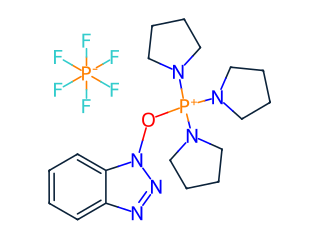
Vaqora Chemicals supplies PyBOP in AR grade, a peptide synthesis reagent registered under CAS number 128625-52-5 at a purity of ≥99%. Formula C18H28F6N6OP2, molecular weight 520.4 g/mol. Systematically, it is named benzotriazol-1-yloxy(tripyrrolidin-1-yl)phosphanium hexafluorophosphate. Alternative names: Benzotriazole-1-yl- and KPC-1068-PI.
In its supplied form it is white to off-white powder or crystals or chunks. Reported physical data include a melting point of 154-156 °C. Store it at 2–8 °C, in a tightly closed container. Under GHS it is labelled “Warning”, so handle it with suitable PPE and consult the SDS.
Typical applications include peptide coupling, solid-phase peptide synthesis and bioconjugation. Our customers for this product work in academic and industrial research and diagnostics and biotechnology.
Standard pack sizes are 1 g, 5 g, 25 g and 1 kg, and every batch ships with a Certificate of Analysis (COA) and we export worldwide.
Typical applications
- Peptide coupling
- Solid-phase peptide synthesis
- Bioconjugation
Industries
Grade guides
Specifications & identifiers
| Product name | PyBOP, GR 99% |
|---|---|
| Catalogue No. | VQ-002428 |
| CAS Number | 128625-52-5 |
| IUPAC name | benzotriazol-1-yloxy(tripyrrolidin-1-yl)phosphanium hexafluorophosphate |
| Molecular formula | C18H28F6N6OP2 |
| Molecular weight | 520.4 g/mol |
| Exact mass | 520.1704 |
| Grade | AR |
| Purity / assay | ≥99% |
| HSN code | 29339900 |
| InChIKey | VIAFLMPQBHAMLI-UHFFFAOYSA-N |
| SMILES | C1CCN(C1)[P+](N2CCCC2)(N3CCCC3)ON4C5=CC=CC=C5N=N4.F[P-](F)(F)(F)(F)F |
| PubChem CID | 2724699 |
| Physical form | Crystalline |
|---|---|
| Appearance | White to off-white powder or crystals or chunks |
| Melting point | 154-156 °C |
| H-bond donors / acceptors | 0 / 13 |
| TPSA | 49.7 Ų |
| Storage | 2–8 °C |
| Synonyms | Benzotriazol-1-yl-oxytripyrrolidinphosphonium hexafluorophosphate, (Benzotriazol-1-yloxy)tripyrrolidinophosphonium hexafluorophosphate, Benzotriazole-1-yl-oxytripyrrolidinophosphonium hexafluorophosphate, 1H-Benzotriazol-1-yloxytripyrrolidinophosphonium Hexafluorophosphate, Benzotriazol-1-yl-oxytripyrrolidinophosphonium hexafluorophosphate, 1-Benzotriazolyloxytripyrrolidinylphosphonium hexafluorophosphate, Benzotriazol-1-yloxytripyrrolidinophosphonium hexafluorophosphate, (Benzotriazol-1-yloxy)tripyrrolidinophosphonium (hexafluorophosphate), Benzotriazole-1-yl-, KPC-1068-PI, benzotriazol-1-yloxy(tripyrrolidin-1-yl)phosphonium hexafluorophosphate |
Safety & hazard information (GHS)


Signal word: Warning
Hazard statements
H302Harmful if swallowedH315Causes skin irritationH317May cause an allergic skin reactionH319Causes serious eye irritationH335May cause respiratory irritationH410Very toxic to aquatic life with long lasting effects
Precautionary statements: P261, P264, P264 + P265, P270, P271, P272, P273, P280, P301 + P317, P302 + P352, P304 + P340, P305 + P351 + P338, P319, P321, P330, P332 + P317, P333 + P317, P337 + P317, P362 + P364, P391, P403 + P233, P405, P501
Classification is indicative (aggregated GHS notifications) and may vary by grade and concentration. Always refer to the SDS supplied with your lot.
Documents
Other grades of CAS 128625-52-5
Frequently asked questions
What is the CAS number of PyBOP, GR 99%?
The CAS Registry Number of PyBOP, GR 99% is 128625-52-5. It is also known as Benzotriazol-1-yl-oxytripyrrolidinphosphonium hexafluorophosphate, (Benzotriazol-1-yloxy)tripyrrolidinophosphonium hexafluorophosphate, Benzotriazole-1-yl-oxytripyrrolidinophosphonium hexafluorophosphate.
What is the molecular formula and molecular weight of PyBOP, GR 99%?
PyBOP, GR 99% has the molecular formula C18H28F6N6OP2 and a molecular weight of 520.4 g/mol. Its IUPAC name is benzotriazol-1-yloxy(tripyrrolidin-1-yl)phosphanium hexafluorophosphate.
Which grade and pack sizes of PyBOP, GR 99% can I order?
We supply PyBOP, GR 99% in AR (≥99%) grade, in 1 g, 5 g, 25 g, 1 kg packs. Larger bulk quantities and custom packing are quoted on request.
Do you provide a COA and SDS with PyBOP, GR 99%?
Yes. Every lot of PyBOP, GR 99% is shipped with a batch-specific Certificate of Analysis, and a 16-section GHS Safety Data Sheet is provided with the quotation and the shipment.
Can PyBOP, GR 99% be shipped internationally?
Yes. PyBOP, GR 99% is classified as hazardous, so it is packed in UN-approved packaging and shipped as dangerous goods under IATA/IMDG rules. We export worldwide on EXW, FOB, CIF and DAP terms.
How should PyBOP, GR 99% be stored?
2–8 °C. Keep the container tightly closed and refer to the SDS for full handling guidance.
Enquire about PyBOP, GR 99%
We reply within one business day with price, pack options, lead time and documentation.
 Australia
 Bangladesh
 Belgium
 Brazil
 Canada
 China
 Egypt
 France
 Germany
 India
 Indonesia
 Ireland
Related products