 VAQORA
Metal Catalysts & LigandsAvailable on request
Thorium oxide, 99%
Synonyms: ThO2 · Thorium oxide (ThO2) · Thorium anhydride · Dioxide, Thorium
CAS No.1314-20-1
FormulaO2Th
Mol. weight264.04
Catalogue No.VQ-018664
Purity99%
HSN28443021
Thorium oxide (CAS 1314-20-1) – catalyst / ligand, 99%. O2Th, MW 264.04. Get a quote from Vaqora Chemicals, COA included, shipped worldwide.
Batch COA with every lot
16-section GHS SDS
Export to 120+ countries
DG-compliant packing
About Thorium oxide, 99%
Vaqora Chemicals supplies Thorium oxide, a catalyst / ligand registered under CAS number 1314-20-1, specified at 99% purity. Formula O2Th, molecular weight 264.04 g/mol. Systematically, it is named dioxothorium. Common synonyms include ThO2 and Thorium oxide (ThO2).
The material typically appears as a white powder. Reported physical data include a melting point of 3,390 °C and a boiling point of 4,400 °C. Solubility: insoluble (water). Store sealed in a dry, well-ventilated location away from incompatible materials. Under GHS it is labelled “Danger”, so handle it with suitable PPE and consult the SDS.
It is commonly used for cross-coupling reactions, homogeneous catalysis, asymmetric synthesis and ceramics and glass. Typical end-use sectors are academic and industrial research, pharmaceutical manufacturing and oil, gas and petrochemicals.
We offer Thorium oxide in 100 mg, 1 g and 5 g packs with a batch-specific COA, and ship to customers worldwide.
Typical applications
- Cross-coupling reactions
- Homogeneous catalysis
- Asymmetric synthesis
- Ceramics & glass
Industries
Specifications & identifiers
| Product name | Thorium oxide, 99% |
|---|---|
| Catalogue No. | VQ-018664 |
| CAS Number | 1314-20-1 |
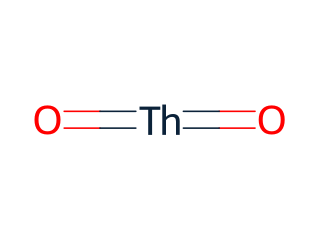
| IUPAC name | dioxothorium |
| Molecular formula | O2Th |
| Molecular weight | 264.04 g/mol |
| Exact mass | 264.0279 |
| Purity / assay | 99% |
| HSN code | 28443021 |
| InChIKey | ZCUFMDLYAMJYST-UHFFFAOYSA-N |
| SMILES | O=[Th]=O |
| PubChem CID | 14808 |
| Physical form | Powder |
|---|---|
| Appearance | White powder |
| Melting point | 3,390 °C |
| Boiling point | 4,400 °C |
| Density | 10.00 g/cm3 |
| Solubility | Insoluble (water) |
| H-bond donors / acceptors | 0 / 2 |
| TPSA | 34.1 Ų |
| UN number | UN 2910 |
| Synonyms | ThO2, Thorium oxide (ThO2), Thorium anhydride, Dioxide, Thorium, Oxide, Thorium, Thorium(IV) oxide, Thorianite, Thorium-232 dioxide, Thorium oxide, >=99.0%, Thorium Oxide Nanoparticle Dispersion |
Safety & hazard information (GHS)


Signal word: Danger
Hazard statements
H301Toxic if swallowedH311Toxic in contact with skinH331Toxic if inhaledH350May cause cancerH373May causes damage to organs through prolonged or repeated exposure
Precautionary statements: P203, P260, P261, P262, P264, P270, P271, P280, P301 + P316, P302 + P352, P304 + P340, P316, P318, P319, P321, P330, P361 + P364, P403 + P233, P405, P501
Classification is indicative (aggregated GHS notifications) and may vary by grade and concentration. Always refer to the SDS supplied with your lot.
Documents
Other grades of CAS 1314-20-1
Frequently asked questions
What is the CAS number of Thorium oxide, 99%?
The CAS Registry Number of Thorium oxide, 99% is 1314-20-1. It is also known as ThO2, Thorium oxide (ThO2), Thorium anhydride.
What is the molecular formula and molecular weight of Thorium oxide, 99%?
Thorium oxide, 99% has the molecular formula O2Th and a molecular weight of 264.04 g/mol. Its IUPAC name is dioxothorium.
Which grade and pack sizes of Thorium oxide, 99% can I order?
We supply Thorium oxide, 99% in (99%) grade, in 100 mg, 1 g, 5 g packs. Larger bulk quantities and custom packing are quoted on request.
Do you provide a COA and SDS with Thorium oxide, 99%?
Yes. Every lot of Thorium oxide, 99% is shipped with a batch-specific Certificate of Analysis, and a 16-section GHS Safety Data Sheet is provided with the quotation and the shipment.
Can Thorium oxide, 99% be shipped internationally?
Yes. Thorium oxide, 99% is classified as hazardous (UN 2910), so it is packed in UN-approved packaging and shipped as dangerous goods under IATA/IMDG rules. We export worldwide on EXW, FOB, CIF and DAP terms.
Enquire about Thorium oxide, 99%
We reply within one business day with price, pack options, lead time and documentation.
 Australia
 Bangladesh
 Belgium
 Brazil
 Canada
 China
 Egypt
 France
 Germany
 India
 Indonesia
 Ireland
Related products
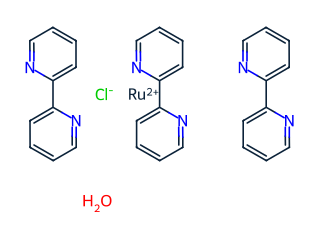
Ruthenium-tris(2,2′-bipyridyl) dichloride, 98%
- CAS
- 50525-27-4
- Formula
- C30H26ClN6ORu+
- MW
- 623.1 g/mol
VQ-018660